Pressision Process Codes
Each Pressision process has its own unique reference code, creating a simple common language between inspiration, design and production.
Use the codes alongside our physical process swatches to explore techniques, understand what’s possible and reference the processes you want to use within your project.
Our physical process swatches are currently in production and will be available to order soon via the website.
Foil Overprinting
Colour and detail over metallic foil
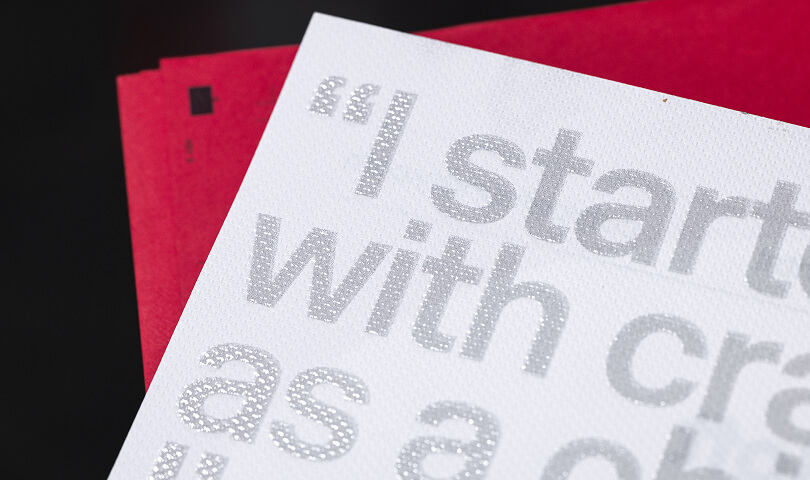
Foil overprinting combines the reflective qualities of metallic foil with printed colour, detail and imagery.
By printing directly over a foiled area, the underlying metallic surface becomes part of the finished design, allowing colour and reflection to interact in ways that conventional printing or foil blocking alone cannot achieve.
Ideal for luxury print and packaging, foil overprinting can create anything from subtle metallic colour shifts to intricate graphic effects with controlled areas of shine and contrast.

Why Foil Overprintning matters
- Greater creative control – Printed colour and detail can be introduced directly over metallic foil to create more complex finishes.
- Custom metallic colours – Transparent or translucent inks allow the reflective foil beneath to influence the final colour.
- Detail with reflection – Typography, patterns and imagery can interact with the metallic surface while retaining areas of shine.
- Distinctive brand finishes – Combines print and foil in a way that can create highly individual visual effects.
Creative Foil Overprinting
- Tinted Metallic Effects – Colour printed over metallic foil creates customised reflective tones beyond standard foil colours.
- Patterned Foil – Printed graphics or textures break up the metallic surface to create controlled areas of reflection.
- Detailed Overprinting – Fine typography, linework and graphic elements can be printed directly across foiled areas.
- Image Integration – Printed imagery can incorporate the foil beneath as part of the highlights, colour and overall composition.
- Registered Foil Overprinting – Print precisely aligned to specific foiled elements for controlled, detailed effects.
What this unlocks for your project
- Luxury packaging with customised metallic colours and graphic detail.
- Book and brochure covers where foil becomes integrated into the printed artwork.
- Invitations and stationery with subtle shifts between colour and reflection.
- Presentation pieces where print, metallic effects and material work together as part of the design.
Tech specs at a glance
- Sequence – Foil is applied before the overprinted elements, making accurate planning and registration essential.
- Ink – Ink selection depends on the required opacity, colour and interaction with the reflective foil beneath.
- Registration – Precise alignment between foil and printed artwork allows detailed effects to be controlled accurately.
- Artwork – Designs should clearly define which areas remain metallic, which are overprinted and how the two finishes interact.
Design tips
- Consider the foil as part of the colour palette rather than simply an additional finishing layer.
- Use transparent or translucent colour where you want the metallic reflection to remain visible through the print.
- Build contrast between printed and exposed foil areas to make the effect more deliberate and legible.
- Discuss the intended result during the design stage so foil, ink and artwork can be tested together before production.
Sustainability
Foil overprinting can achieve complex metallic effects using a controlled combination of foil and printed ink rather than multiple decorative layers.
Material, foil and ink choices can be considered together to maintain compatibility with recyclable fibre-based print and packaging wherever the project allows.
Foil Overprinting FAQ's
Essential tips and guidance to ensure your next project runs seamlessly.
Fill in our enquiry form and we will get back to you as soon as we can.
Make enquiryExplore other processes


Explore embellishment options
Discover how specialist finishes can elevate your print.